
Traditionally seen as a topic shrouded in mystery behind a veil of tech wizardry and industry know-how, more business owners with a website are now trying Search Engine Optimisation (SEO).
While dabbling in a little DIY on-page optimisation is unlikely to damage the online visibility of your business, just how badly can mistakes harm SEO?
Discover some of the most common SEO mistakes, why they should be avoided, and how you can learn from them.
The most common SEO mistakes to avoid
1. Creating content for the sake of content
Why to avoid: Yes, Google does love content, but that doesn’t mean that creating content – just for the sake of getting something on your site – is the most effective SEO strategy.
In fact, this type of content is typically seen as low-quality ‘filler’ content which can damage trust and reduce engagement, leading to both lower SEO rankings and wasted resources.
How to avoid: Always start with a clear strategy when you’re deciding what kind of content you should write and publish online. Whether you want to improve awareness of a new product line, or drive more traffic to a lesser-known service, your content should have a clear purpose that resonates with your target audience.
Often, understanding the kind of content your target audience is looking for starts with conducting keyword research.
This will help you to pinpoint the terms that they’re actively typing into Google and other search engines, giving you key topics, pain points, and keywords to focus your content around.

2. Getting stuck in a content silo
Why to avoid: Related to creating content for the sake of content is the issue of finding yourself trapped in a ‘content silo’.
This is where a keyword is plucked from a list, bolstered by internal conversations, and used as a pillar for all following content.
However, this approach fails to uncover exactly how users are applying this keyword and its variations, which can lead to the creation of content that the website’s audience doesn’t really care about.
How to avoid: Do your research – speak to your customer service team, ask your target audience to fill out a survey, and consult with your sales team to find out how your audience understands these keywords.
We also recommend Googling the keyword, which can help you with seeing how users are applying it, whether there are any synonyms unbeknownst to the business, and which results appear highest in the organic search results.
3. Targeting multiple keywords with one page
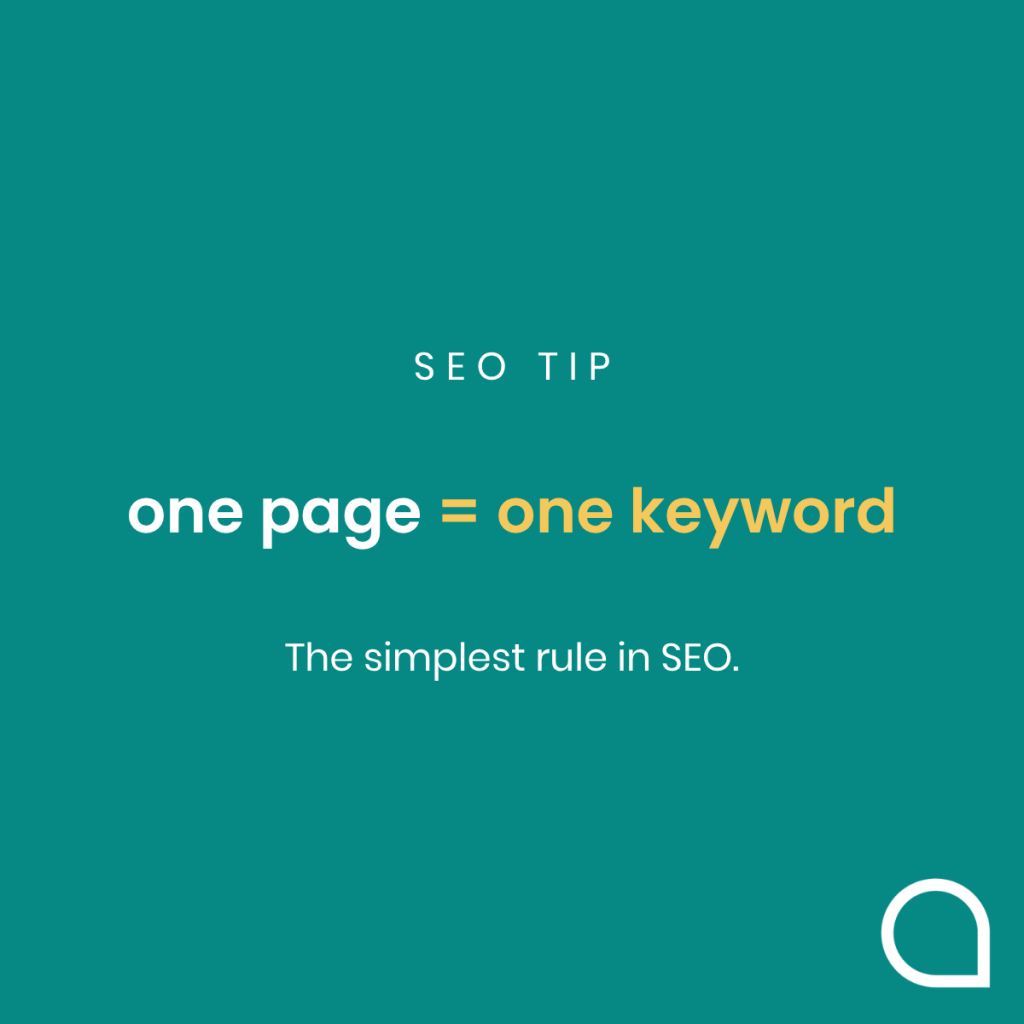
Why to avoid: Another one of the most common SEO mistakes to avoid with regards to content creation is trying to rank one page for multiple keywords. In short, incorporating too many unrelated keywords into just one page can dilute the topic authority and have a negative impact on user experience.
How to avoid: At Aqueous Digital, we have a key rule we follow when creating content: one page = one keyword. While we do optimise some pages for several keywords, they always share the same search intent and are semantically related.
For example, a location, service-based page for ‘SEO in Cheshire’ shouldn’t also be optimised for informational keywords like ‘Why is SEO important?’.
This is because the user search intent behind ‘SEO in Cheshire’ is to find an agency that provides this service within the location.
In short, they already know they need SEO and are exploring suitable service provider options.
‘Why is SEO important?’, however, is an informational keyword phrase, meaning the user search intent is to find educational content, such as a blog, video, or guide that outlines the benefits of investing in this type of digital marketing activity.
Put simply, the user is looking to learn more about the service and whether it’s right for them – rather than to find a service provider.
SEO agencies and SEO tools with keyword research capabilities, like Semrush or Moz, can help you to assess the user intent of relevant keywords and create content where pages are optimised with the right keywords.
In turn, this ensures your content satisfies user search intent and is relevant to the query, helping to improve rankings and the online visibility of your site.
4. Changing domains without planning
Why to avoid: Often, when businesses are in their infancy and branding is an ongoing process, it’s not uncommon for website owners to set up the website with one brand name and then change it further down the line after refining their brand identity.
However, doing this can lead to significant SEO consequences.
But don’t just take our word for it – find out first-hand from Benjamin Lebus, CEO and Founder of Mob, who watched five years of site authority and trustworthiness go down the drain when he changed his site domain from ‘mobkitchen.com’ to ‘mob.co.uk’.
How to avoid: While we would always recommend keeping your domain name wherever possible, damage to your site’s SEO efforts when changing domains can be mitigated through careful planning and proper 301 redirects.
We strongly suggest that the process of changing domains is overseen by SEO technicians who have significant experience in this area and can help your site to retain as much authority, backlinks, and traffic as possible, while simultaneously limiting damage and disruption.

5. Ignoring your authority score
Why to avoid: Another of the top SEO mistakes to avoid is ignoring your authority score.
Every website will have an authority score – often measured on a 100-point scale by an SEO tool like Semrush or Moz – that predicts a domain’s ability to rank in the SERPs (Search Engine Result Pages).
Generally, the higher the score, the higher the site’s rankings, trust, authority, and reputation.
As a result, this score can be a strong indicator of the successfulness of your SEO efforts and use accordingly to help point future SEO activities in the right direction.
How to avoid: Investing in an SEO tool (or enlisting help from an SEO agency with access to one of these tools) can help you to stay abreast of any changes to this important score and implement any changes to either maintain or improve your existing score.
6. Building links to low-quality sites
Why to avoid: While buying links for your website has long been known to negatively impact domain authority, building low-quality backlinks (that’s backlinks to irrelevant, untrustworthy, or spammy sites) can also substantially harm your site’s SEO efforts.
While it’s easy for website owners to build these links through automated, mass-produced methods, search engines view these techniques as manipulative and can enforce SEO penalties on the site, resulting in traffic loss and decreased online visibility.
How to avoid: A more effective link-building method is the creation and promotion of high-quality ‘linkable assets’.
This might be in the form of an infographic, data study, or original thought-leadership-style insight, for example.
Once created, these assets can be promoted through outreach to relevant, high-quality websites that want to link to them, helping the website to naturally secure backlinks from authoritative and reliable sources, rather than from low-quality, SEO-hampering ones.
7. Disregarding the value of digital PR (Public Relations)

Why to avoid: Far too often, digital PR is ignored entirely by website owners – either through lack of awareness or apprehension over how to start.
However, by leveraging online channels, digital PR can help websites to earn high-quality coverage, backlinks, and brand mentions across the internet.
Digital PR activities can involve everything from producing linkable assets for industry-relevant publications to offering expert guidance on topical issues that more general online news sites can pick up.
How to avoid: You can avoid this common SEO mistake by simply seeking education on the importance of digital PR – especially following the introduction of AI (Artificial Intelligence) search tools and Google’s focus on E-E-A-T (that’s Experience, Expertise, Authoritativeness, and Trustworthiness).
This framework emphasises credibility and although it is not a direct ranking factor for Google, digital PR can play a pivotal role in positioning your brand as an authoritative, trusted expert in your field by helping you to earn online coverage, build quality backlinks, and get mentioned in industry publications.
8. Neglecting on-page SEO basics
Why to avoid: While search engines are undoubtedly getting smarter and can understand the content on a page through various methods, one of the easiest ways to communicate with them is through on-page SEO, such as meta titles, descriptions, headings (H1, H2), and image alt text.
Subsequently, not including these on-page basics can mean Google and other search engines struggle to fully understand what a page is all about, resulting in lower online visibility for queries you want the page to rank for.
Another issue, which is common for new websites trying to save time getting up and running, is duplicating meta descriptions across pages.
This often confuses both search engines and users, which negatively impacts online visibility and reduces click-through rates (CTRs).
How to avoid: Whether you’re starting a new site from scratch or have a website with hundreds of pages that you simply haven’t gotten round to optimising with on-page SEO, it’s important to carve out time in your schedule to create unique and keyword-optimised meta titles and meta descriptions.
Other important on-page SEO elements that should also be optimised includes URLs, image alt text, and internal linking.
If you’re unsure where to start or how to do this, it’s often best to consult with an SEO agency who can guide you in the right direction and prevent you from making any on-page SEO mistakes.
9. Relying too heavily on Google
Why to avoid: Naturally, Google is important in the SEO world as it possesses more than 90% market share, making it the most dominant search engine in the industry – by a mile. However, one of the biggest mistakes website owners can make is relying too heavily on this search engine behemoth – and – SEO in general.
By investing all your time, energy, and resources into just SEO and Google, you run the risk of sudden, severe drops in both revenue and traffic. This could be following an algorithm update, new competitor, or fundamental change to the search landscape, such as the introduction of AI Overviews.
How to avoid: Alongside investing in SEO, you should also look at other digital marketing avenues, such as social media and email marketing, as well as traditional marketing activities, and the various ways they can support your business and reduce overreliance on Google.
More than an SEO agency, our team is committed to the success of your business.
This means advising on other avenues of marketing (even if we don’t provide that service) and even making introductions to trusted partners, such as video production agencies, that would add value.

10. Viewing SEO as a one-off job
Why to avoid: When you see SEO as a one-off task, it’s likely that you’ll create a website and optimise it with SEO in mind, then never update it again.
However, SEO is a constantly evolving area of digital marketing as algorithms change and new search features are introduced.
Failing to update on-page SEO, create new content, update older content, and change your approach in response to the developing search landscape will stagnate your SEO efforts and naturally lead to a gradual dip in traffic and online visibility.
How to avoid: One of the most effective ways to stay on top of your SEO is to carry out regular content audits and ensure your website is still relevant and fit for purpose for your target audience.
This content audit will help you to identify areas that require updating and implement the necessary changes to keep your site’s content fresh.
You can either do this yourself or enlist expert support from an agency like Aqueous Digital.
Avoid SEO mistakes altogether with Aqueous Digital
Unfortunately, it’s all too common for in-house marketers and website owners to make SEO mistakes – even when they have the best intentions!
Whether you’re trying to make the site more aesthetically pleasing at the expense of a clear structure or haphazardly dishing out content, it’s easy to fall into these common SEO pitfalls.
Fortunately, Aqueous Digital is composed of a team of highly-experienced digital marketing professionals at the forefront of SEO best practices.
This ensures we’re abreast of Google algorithm updates, advances in relevant technology (such as AI), and new SEO tools.
As specialists in both paid and organic online search, you can trust our team to drive positive SEO results for your website – whether that’s improved rankings for business-critical keywords, greater brand awareness, or an increase in enquiries.
To learn more about our tailored SEO packages or to book your free, no-obligation consultation, simply give our friendly team a call today on 0800 285 1424.
We also welcome both email enquiries made to hello@aqueous-digital.co.uk and those submitted using our convenient online contact form.